Published September 16, 2026
AI Technologies in 2026: Closed, Open-Weight, Local, Multimodal, MoE and Diffusion Compared
A practical technical guide to the major competing AI technologies in 2026, from closed and open-weight models to local AI, multimodal systems, Mixture of Experts, diffusion and AI agents.
On This Page
- First: A Model, Product and Technology Are Not the Same
- 1. Closed Models
- 2. Open-Weight Models
- 3. Local AI
- 4. Transformer: A Foundation of Many Modern Models
- 5. Mixture of Experts: More Capacity with Sparse Activation
- 6. Multimodal AI: Working Across Multiple Data Types
- 7. Diffusion: A Major Approach to Image and Video Generation
- 8. AI Agents: From Answering to Executing Tasks
- Technology Comparison
- How to Choose the Right Technology
- The Biggest Mistake When Comparing AI Technologies
- Frequently Asked Questions
- What is the difference between Open Source and Open-Weight AI?
- Is local AI better than cloud AI?
- What is Mixture of Experts?
- What is diffusion used for in AI?
- Conclusion
The AI race is no longer just a contest between product names. Behind services such as ChatGPT, Gemini and Claude are different models, architectures and deployment approaches, each with different strengths, costs and constraints. The question “Which AI is best?” is less useful unless the task, environment, budget and privacy requirements are defined.
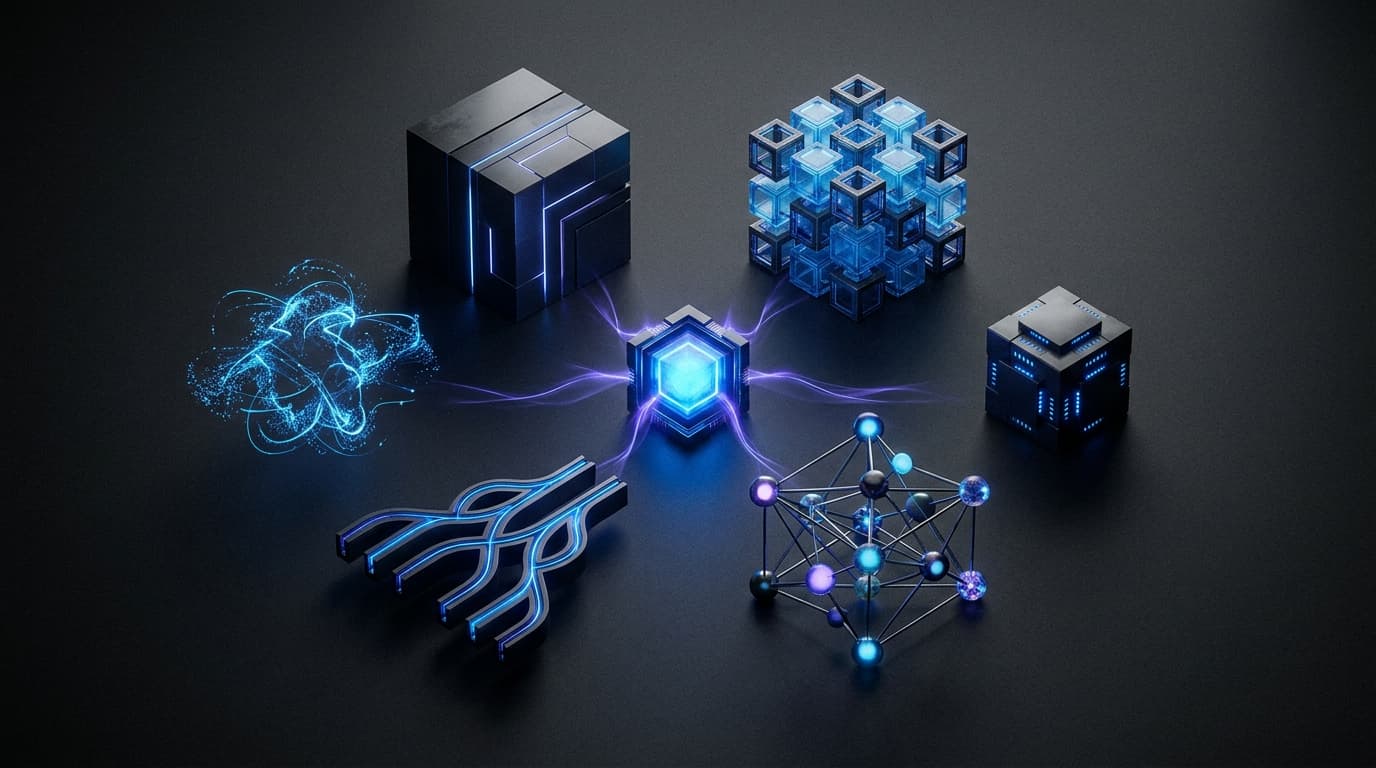
In 2026 the landscape is more diverse: closed cloud models, open-weight models, local AI, multimodal systems, Mixture-of-Experts architectures, diffusion models for images and video, and agents that can use tools and execute multi-step tasks. These are not interchangeable categories; some describe different layers of the same system.
First: A Model, Product and Technology Are Not the Same
A model is the learned system used for inference. A product is the service that wraps one or more models with an interface, tools, memory, search and integrations. A technology or architecture describes how a system is built, such as Transformer, Mixture of Experts or diffusion. Different products can therefore use related architectural ideas, while one product can combine multiple models.
1. Closed Models
With a closed model, users generally do not receive the model's complete weights and instead access it through a provider's service. This lets the provider centrally manage infrastructure, updates, safety systems, tools and integrations.
- Strengths: ease of use, no need to own powerful hardware, centralized updates, and integrated tools and services.
- Weaknesses: provider dependency, possible changes to pricing, policies or models, and less control over deployment and customization.
- Best fit: when you want advanced capabilities without managing the infrastructure yourself.
2. Open-Weight Models
Open-Weight is more precise than using Open Source as a blanket term. Model weights may be downloadable or runnable while training data, training code or other components may not be available under the same terms. The license of each project should therefore be checked, especially for commercial use.
- Strengths: greater control over hosting, customization and infrastructure choice.
- Weaknesses: technical expertise, suitable memory and compute requirements, and license considerations.
- Best fit: when you need greater control over data, customization or infrastructure.
3. Local AI
Local AI runs inference on the user's computer or on a private server under the user's control rather than sending every request to a cloud service. It can be valuable for privacy, offline operation, development and data control.
- Strengths: greater data control, offline operation after model download, and less dependence on a cloud provider.
- Weaknesses: RAM and GPU/CPU requirements, power use, slower performance on weak hardware and model-management complexity.
- Important note: model size is not the only performance factor; quantization, memory, bandwidth, context size and hardware all matter.
4. Transformer: A Foundation of Many Modern Models
Many language, vision and multimodal models build on ideas from the Transformer architecture, where attention mechanisms are central to representing relationships across a sequence. Transformer alone does not determine model quality; data, training, post-training, inference, context handling and task design also matter.
5. Mixture of Experts: More Capacity with Sparse Activation
In a Mixture-of-Experts architecture, multiple expert subnetworks are available and a router selects a subset for each token. The idea is to increase total model capacity while activating only part of the parameters for a given input instead of using all parameters at every step.
- Strengths: high total capacity with fewer active parameters per token and the possibility of distributing different patterns across experts.
- Weaknesses: more complex training and serving, expert-routing communication, and potentially large total memory requirements.
- Bottom line: MoE does not automatically mean a model is faster or better; efficiency depends on implementation, hardware and routing.
6. Multimodal AI: Working Across Multiple Data Types
Multimodal systems work across modalities such as text, images, audio, video and documents. The important capability is not simply accepting an image alongside text, but connecting information across modalities for understanding, reasoning and task execution.
- Strengths: image and document analysis, audio and video understanding, and cross-modal information linking.
- Weaknesses: higher compute costs, harder evaluation and the possibility of perceptual errors even when the language output sounds convincing.
- Best fit: when a task contains text plus images, audio or video rather than text alone.
7. Diffusion: A Major Approach to Image and Video Generation
Diffusion models work differently from autoregressive language models. In simplified terms, the model learns to progressively remove noise from a corrupted representation to reach structured content. Diffusion methods have become important for image generation and editing and have expanded into video and other generative applications.
- Strengths: strong visual quality, flexible generation and editing, and control through text, reference images and editing techniques.
- Weaknesses: generation cost, compute requirements and consistency challenges across multiple frames or shots in some video scenarios.
- Best fit: when the task is generative visual creation or editing.
8. AI Agents: From Answering to Executing Tasks
An AI agent is not necessarily a new model. It is often a system that combines a foundation model with tools, memory, planning, execution and monitoring loops. It can read a file, search, run code or call an API and then use the result to decide the next step.
- Strengths: multi-step automation, tool use and interaction with work environments.
- Weaknesses: error accumulation, permission issues, repeated model-call costs and the need for safeguards against unintended actions.
- Best fit: when the task is a workflow rather than a single question and answer.
Technology Comparison
| Technology | Main strength | Main constraint | Best fit |
|---|---|---|---|
| Closed Models | Managed ready-to-use capability | Provider dependency | General cloud use |
| Open-Weight Models | Greater control and customization | Hardware, licensing and operations | Hosting and customization |
| Local AI | Privacy and control | Hardware requirements | Sensitive data and offline use |
| Transformer | Context and relationship modeling | Compute cost at large scale | Language, vision and multimodal systems |
| MoE | Large capacity with sparse activation | Serving complexity | Large-scale models |
| Multimodal | Cross-modal capability | Higher cost and harder evaluation | Text, image, audio and video |
| Diffusion | Strong visual generation and editing | Generation cost and consistency | Images and video |
| AI Agents | Multi-step execution | Reliability and control | Automation and workflows |
How to Choose the Right Technology
- Define the data type: text, image, audio, video, documents or a mixture.
- Define privacy requirements: can the data be sent to a cloud provider or must it stay on a device or private network?
- Define compute constraints: memory, GPU/CPU, speed and power consumption.
- Define customization needs: a ready model, private hosting or fine-tuning?
- Define the task: answering, generation, analysis, research or multi-step execution.
- Compare total cost, including infrastructure, storage, maintenance and development time.
- Test on your real workload; public benchmarks do not guarantee the same performance for a specialized task.
The Biggest Mistake When Comparing AI Technologies
The mistake is turning a multidimensional technical comparison into a single ranking. A system can be excellent for coding but unsuitable for video generation, while a local system can have lower raw capability than a cloud service yet fit a project that must keep data on-device. A useful comparison starts with the task and constraints, then evaluates performance, cost, privacy and reliability.
Do not start with “Which is strongest?” Start with “What is the task, and which constraints are non-negotiable?”
Frequently Asked Questions
What is the difference between Open Source and Open-Weight AI?
Open-weight means model weights are made available under specific licensing terms. It does not necessarily mean the training data, training code and every component are open under the same terms. The project's license should be checked.
Is local AI better than cloud AI?
Not universally. Local AI offers greater control and privacy and can operate offline, while cloud AI provides access to large models and infrastructure without requiring local hardware. The choice depends on the task, data and budget.
What is Mixture of Experts?
MoE is an architecture with multiple expert subnetworks where a router selects a subset to process each token, increasing total capacity while activating only part of the parameters for an input.
What is diffusion used for in AI?
Diffusion methods are widely used for image generation and editing, with applications extending to video and other generative tasks.
Conclusion
AI competition in 2026 spans several layers: closed versus open-weight models, cloud versus local deployment, text versus multimodal systems, dense versus MoE architectures, generative approaches such as diffusion, and agentic systems that use models to execute complete workflows.
There is no single technology that dominates every context. A sound technical choice matches the technology to the task and constraints: data type, privacy, hardware, cost, customization and reliability. This makes AI-tool comparison grounded in real requirements rather than a universal ranking.
Read also
How to Write a Professional AI Prompt: Complete Prompt Engineering Guide
Learn how to write better AI prompts for ChatGPT and other AI tools with a practical framework, ready-to-use template, examples, and common mistakes to avoid.

AI Detectors: Do They Actually Work? Tested and Explained
Tools claiming 99% accuracy at detecting AI-written text. The reality is far messier, and blindly trusting them can unfairly accuse a completely innocent human writer.

What Is a Token, Really? A Non-Technical Explanation
You hear "token" everywhere: usage limits, subscription pricing, context window size. But what does it actually mean? A simple explanation, no math, no jargon.